

The Future of Roads: Microcapsules That Heal

By Sarah Shahin

Figure 1

Visual representation of the bitumen filled microcapsules in asphalt pavement healing cracks (Zghoundi et al., 2023)

Imagine you are driving over a tiny crack in the road. Small dents in the pavement that do not really bother you. After all, you would not actually feel it, right? But, over time, those small cracks will grow into bigger cracks before becoming potholes due to repeated stress, weathering, and freezing cycles. That is when they really become noticeable. Those large holes become dangerous to drivers and damage vehicles, but what if they could heal themselves?

Road maintenance is costly, labor-intensive, and time-consuming, but scientists are developing microcapsules filled with a petroleum-based mixture called bitumen. These capsules can be mixed into the asphalt one at a time through paving, as filling in the microcracks early on prevents the cracks from becoming a bigger problem. For example, when a crack—so small that it cannot be seen—forms in the road, the microcapsules are ruptured and release the bitumen. As it cures over the next few days, it will still be safe to drive and walk over it as per usual.

How is this Cost Effective and Sustainable?

This solution means a 10-15% higher cost for road pavement. But the amount of money that will potentially be saved over time in maintenance costs will make the initial sacrifice worth it. Scientists are also looking at using cooking oil waste in the bitumen. Recycling the cooking oil would be a step towards achieving sustainable development of road engineering (Xu Xu., 2025). These microcapsules can achieve impressive recovery rates, with healing efficiencies ranging from 30% to 90% (Zghoundi et al., 2023), making the investment worthwhile and saving millions long term. Road repairs are expensive, time-consuming, and harmful to the environment. In the United States alone, 169 billion dollars are spent annually on roadway repair, and globally, pothole-related damage costs more than 100 billion dollars worldwide. Repairing potholes can take several hours and sometimes even days. These processes have awful effects on the environment as well. Successfully reducing the number of times roads need to be repaired would be a great achievement.

Why would this be Meaningful and Helpful?

Worldwide, there have been around 1.3 million deaths and injuries related to potholes, and 240 million tires are damaged in the United States each year due to potholes. Many American roads have been around for longer than they were originally designed to last, often being around 50 years old when they were originally only intended to last 20-30 years. In 2022, research completed by the Bureau of Transportation Statistics showed that out of 786,000 miles of roadway across the United States, 157,000 miles are in poor condition. Improving the condition of American roads is a crucial step towards better infrastructure in the United States.

Scientists have been looking at different vessels for the self-healing mechanism as well, such as plant spores. At Swansea University, a team of scientists did lab tests where bitumen-filled plant spores repaired small fractures within an hour of them first appearing (Guardian, 2025). In China, the world’s first self-healing road was built in 2014. After observing the roads for many years, data showed a significant reduction in microcracks.

Obstacles

There are barriers and setbacks to the implementation of the bitumen microcapsules. The initial cost would be significantly higher, around 10-15%, but this money would be saved once the microcracks start to form, and less money needs to be spent on repairs. There is also limited knowledge about the consequences of the broken microcapsules remaining in the bitumen after the self-healing process is done, and whether it will impact the effectiveness of the binding agent. There are also questions about whether or not the bitumen capsules could work in pre-paved roads. If scientists and engineers, through testing and analysis, can find answers to these questions, the results could be astounding.

Future Opportunity

Looking forward, monitoring systems and predictive technology, enhanced with AI, could lead to roads that can self-monitor and self-repair. Zero-maintenance roads, requiring very little human intervention, combined with smart and sustainable technology, could be an extraordinary innovation.

Self-healing asphalt is the future of infrastructure and road repair. It can help reduce fatalities due to potholes and save billions of dollars worldwide. Now more than ever, the world is looking for sustainable solutions to problems like potholes, and these microcapsules are an incredible option.

Bibliography:

Jiang, T., Cao, X., Hao, Z., Wei, K., Shan, B., & Tang, B. (2025). Adaptability of microcapsules in asphalt and their enhancement of flowability and self-healing. Journal of Industrial and Engineering Chemistry. https://doi.org/10.1016/j.jiec.2025.06.042

Yang, P., Wang, L.-Q., Gao, X., Wang, S., & Su, J.-F. (2021). Smart Self-Healing Capability of Asphalt Material Using Bionic Microvascular Containing Oily Rejuvenator. Materials, 14(21), 6431. https://doi.org/10.3390/ma14216431

Zargar, M., Su, J. F., & Sun, D. Q. (2021, February 6). Understanding the final surface state of self-healing microcapsules containing rejuvenator in bituminous binder of Asphalt. Colloids and Surfaces A: Physicochemical and Engineering Aspects. https://www.sciencedirect.com/science/article/abs/pii/S0927775721001564 

Estimator53. (2024, July 27). How Much Does a Mile of Asphalt Cost? Estimate Florida Consulting. https://estimatorflorida.com/how-much-does-a-mile-of-asphalt-cost/

Coach, T. S. (2025, April 11). Self-Healing Asphalt with Plant Spores and AI. TorontoStarts. https://torontostarts.com/2025/04/11/self-healing-asphalt-revolution/

Xu, Xu, (2025, June 21) “Application of Microencapsulated Waste Cooking Oil in Bitumen: Responsiveness and Bitumen Performance Changes.” Fuel, vol. 402, 21 June 2025, p. 136026, www.sciencedirect.com/science/article/abs/pii/S001623612501751X, https://doi.org/10.1016/j.fuel.2025.136026.

Zghoundi, Y., Akkouri, N., Taha, Y., & Boutgoulla, M. (2023). Self-healing Microencapsulation Technology for Asphalt Pavements: A Review. NanoWorld Journal, 9. https://doi.org/10.17756/nwj.2023-s2-058

Guardian News and Media. (2025, February 3). Farewell potholes? UK team invents self-healing road surface. The Guardian. https://www.theguardian.com/science/2025/feb/03/farewell-potholes-uk-team-invents-self-healing-road-surface
Lakes: How they form and their vital role in the environment 

By: Elizabeth Ann McNulty 

Millions of lakes can be found around the world! Lakes are bodies of water surrounded by land, and they vary greatly in size, depth, location, and origin, and there is a story behind how each lake forms. Additionally, lakes also play a key role in ecosystems, providing us with water, food, plants, and sustaining diverse species that depend on these lakes for their survival. They are mainly affected by temperature, wind, and light, which all vary based on the location of the lake. Since lakes form in many different ways, such as through glacier activity, tectonic movement, volcanic activity, river systems, and human engineering, understanding these processes is essential for recognizing the important roles lakes have in maintaining a healthy environment (Lake, 2023). 


Glacial Lakes:    Above is an image of a glacial lake (Aerial, 2017). 

Glaciers are massive bodies of snow and ice that have accumulated over thousands of years and move slowly across land. During the last Ice Age, many lakes formed when these glaciers moved across the land, carving out deep basins.  When the climate started to warm up around 10,000-15,000 years ago, the glaciers began to melt, and the water from the glaciers dripped and flowed down to fill these spaces, creating lakes. This process is one of the most common processes of lake formation, and it mainly occurred in regions such as Europe and North America (Knibb, 2023). 


Tectonic Movement :  Above is an image of a tectonic lake, called the Caspian Sea, which is the world’s largest lake, located between Asia and Europe. (Schmalz, 2010) 

Seven major tectonic plates make up the crust of the Earth and have been moving throughout history. This movement causes volcanic eruptions, earthquakes, formation of mountains, but it can also lead to the creation of lakes. Tectonic lakes are created as a result of the deformation of the Earth’s crust. When the crust fractures or folds along the fault lines, basins or depressions are developed, which gradually fill with precipitation, groundwater, or inflowing streams to become lakes. They are essential because they act as water storage, provide unique habitats for species, as well as recreation (Tectonic, n.d.). 

Volcanic Activity : Above is Crater Lake located in the caldera of Mount Mazama, Oregon. It is one of the deepest and clearest lakes in the world.  

Some lakes form when the crater (also known as the caldera) of inactive volcanoes fill up with rain or snow once a volcano becomes inactive, creating what are known as crater lakes. Volcanic lakes are produced by volcanic activity and are often referred to as volcanogenic lakes because they originate from volcanoes, with crater lakes being the most common type. Lava lakes are rare, and temporary types of lakes found in active volcanoes occur when molten lava collects in a depression and partially fills it (Volcanic, n.d.). 

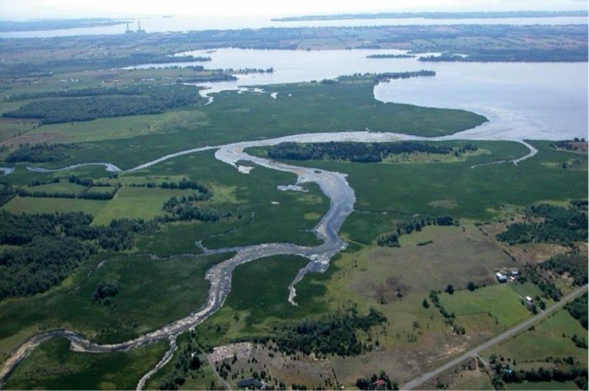
Fluvial Lakes: Above is an image that shows a fluvial lake in the Great Lakes Coastal Wetlands (An example, 2021), 

Fluvial lakes are bodies of water formed by the movement of running water from rivers changing their course and developing into unique basins. These lakes are shaped by geomorphological processes such as erosion, channel migration, and deposition. When the rivers shift, they leave behind cutoffs or depressions that create fluvial lakes. They are open lakes, meaning that they connect to rivers, and differ from closed lakes: lakes that do not connect to any rivers. They have a key component in floodplain ecosystems, where they act as natural storage areas and provide habitats for fish, and other wildlife, supporting biodiversity. Fluvial lakes contribute to resources we use in daily life, such as improving water quality and running nutrient dynamics (Fiveable, 2024). 


Artificial Lakes: Above is an image of Lake Kariba in Central Africa, which is the largest man-made lake in the world (The Editors, 2025). 

In addition to all these lakes formed by natural processes, humans create lakes for purposes such as water storage, flood control, wildlife habitat, and hydroelectric power. Engineers carefully plan the shape, location and design of the lakes to make sure it is sustainable and beneficial to the surrounding environment. First, experts decide which depression, basin, or valley to use by conducting geographic surveys and environmental studies. Builders then construct a dam from materials like concrete, rock, or earth to block the natural flow from running water of rivers. The reservoir fills with precipitation, river inflow, and groundwater, and water management systems are installed to help regulate the levels of the water in the lake and aid in producing electricity. These new lakes transform ecosystems by supporting habitats for fish, birds, and plants, as well as helps provide us with clean water, power, recreation and drinking water. (How are, n.d.) 

From natural processes like the movement of glaciers, tectonic plates, or rivers, to human-made reservoirs, every type of lake helps contribute to biodiversity and maintains a healthy ecosystem by regulating water systems and providing unique habitats for wildlife.  

Bibliography:

Aerial view of body of water : lake in the mountains [Photograph]. (2017, August 22). Unsplash. https://www.sciencealert.com/study-says-glacier-lakes-are-accelerating-disappearance-of-permanent-ice

An example of a riverine Great Lakes coastal wetland [Photograph]. (2021, January 19). United States Environmental Protection Agency. https://19january2021snapshot.epa.gov/great-lakes-monitoring/summary-great-lakes-coastal-wetland-monitoring-program-cwmp_.html   

Fiveable. (2024, August 20). 1.3 Fluvial lake formation – Limnology. https://library.fiveable.me/limnology/unit-1/fluvial-lake-formation/study-guide/1NC17gh2C0HPgTbw   

Gautier, A. (2022, February 15). What are glacial lakes? National Snow and Ice Data Center. Retrieved September 3, 2025, from https://nsidc.org/learn/ask-scientist/what-are-glacial-lakes   

How are man made lakes made. (n.d.). Western Liner. Retrieved September 7, 2025, from https://westernliner.com/blog/how-are-man-made-lakes-made/   

Knibb, F. (2023, September 27). How are lakes made? Deep Sea World. Retrieved September 3, 2025, from https://www.deepseaworld.com/water/how-are-lakes-made/   

Lake. (2023, October 19). National Geographic. Retrieved September 1, 2025, from https://education.nationalgeographic.org/resource/lake/  

Schmaltz, J. (2010, June 4). NASA Caspian Sea [Photograph]. https://earthobservatory.nasa.gov/images/44253/caspian-sea  

Tectonic lakes. (n.d.). Prepp. Retrieved September 6, 2025, from https://prepp.in/news/e-492-tectonic-lakes-types-of-lakes-geography-notes  

The Editors of Encyclopaedia Britannica (2025, January 31). Lake Kariba. Encyclopedia Britannica. https://www.britannica.com/place/Lake-Kariba  

Volcanic lakes. (n.d.). Prepp. Retrieved September 6, 2025, from https://prepp.in/news/e-492-volcanic-lakes-types-of-lakes-geography-notes  

The Golden Ratio: Superstition or Science?

By Alondra Caba

Whether it is Pi (π) day, the pursuit of many to memorize thousands upon thousands of digits, or eating celebratory pies in its honor, this irrational number is never short of fame every year. Phi, however, does not fall too far behind. It is best known as the “golden” ratio, and appreciated for its “natural” presence in nature, art, and society. However, is it really as mystical as people believe? The Pythagoreans were horrified at the thought of any irrational numbers, but were their fears reasonable? Though the mathematics behind the golden ratio are relatively simple, its irrationality, so to speak, is something that can be appreciated regardless of any superstitious value or otherwise. 

Fibonacci Numbers, Phi, and the Golden Ratio

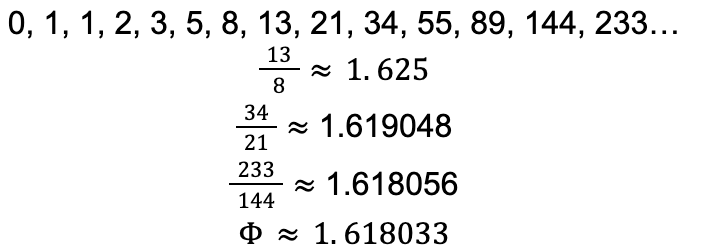
To understand phi (Φ) and the golden ratio, it is important to first understand the Fibonacci sequence. The Fibonacci sequence is an example, specifically the most popular, of a recursive sequence. A recursive sequence is a series of numbers defined by at least one of its preceding values (Morris., n.d.) Thus, the Fibonacci sequence is a type of recursive sequence where each number in the sequence is a sum of the two values that precede it. Algebraically, it is expressed as FN = F(N-1) + F(N-2). It is important that, though the Fibonacci sequence is standardized by its two starting numbers 0 and 1, the sequence can be achieved with any two starting values. The reason why is because any series of Fibonacci sequences share a vital characteristic: the ratio between sequential values will get closer and closer to the golden ratio, Φ. For example, in the following standard sample of the Fibonacci sequence, the later ratios are closer to 1.618 (the rounded value of phi) than the previous ones:

Although the Fibonacci sequence was found to have a relationship with the golden ratio, the history of the golden ratio actually precedes Fibonacci’s numbers. The golden ratio was identified as far back as 300 B.C.E, though not by name. Euclid’s Elements repeatedly highlights the idea of a straight line divided into “extreme and mean ratio” (Heiberg, 2008). His book, which provides proofs and definitions for elementary geometry, provides a geometric visualization of the golden ratio. Euclid claims that a straight line is in extreme and mean ratio when “as the whole is to the greater segment so the greater (segment is) to the lesser” (2008). In other words, given a straight line ABC segmented at point B where AC represents the whole, AB is the longer part, and BC is the shorter part; the ratio of AC to AB is equal to the ratio of AB to BC. Phi is, essentially, the relationship between the line segments when split into this special “extreme and mean ratio.” 

Basic Formula of Phi

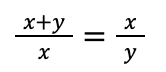
Euclid’s Elements provides an accurate geometric representation of the golden ratio, but it can be expressed algebraically as well. Assuming that the greater and lesser segments are instead defined as values x and y, x and y are in the golden ratio when the following equation is true:

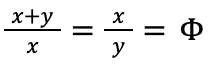
Thus, the ratio is algebraically defined as the following equation:

However, this equation does not give an exact value of Φ. Rather, it just shows the conditions that must be met to fulfill the ratio. A solution to this is to set y equal to 1, creating a unit ratio that is still equivalent to the original equation. This way, y = 1, and we can say that x = Φ (Choi et al. 2023). The new equation is now 

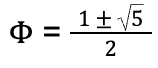
Solving for can be done with algebra and creating the quadratic equation Φ2 – Φ – 1 = 0. With the quadratic formula, we can find the following solutions:

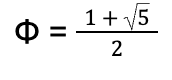
Of the two solutions, the golden ratio, , is the positive root. Keeping in mind Euclid’s geometric representations, it is impossible to have a “negative” line segment. Thus, it’s vital that the equation is the positive solution. Therefore:

Is it Superstition or Science?

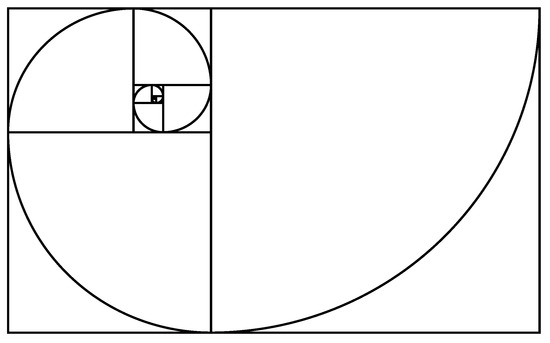
Visually, the golden ratio is so special because the sequence creates a spiral image. The best example of this is the “golden rectangle” in which the side lengths of the rectangle are in the golden ratio. This is done by splitting the rectangle into a square and another smaller rectangle. Within this smaller rectangle, another square can be placed, and the cycle continues to make similar rectangles all in the golden ratio. Then, arcs can be drawn through each square to create the spiral.

(Marples & Williams, 2022).

However, though spirals are common patterns in nature, this does not grant a “mystical” power to the golden ratio. Rather, the mathematical value of the golden ratio is something that can be utilized and applied in different disciplines. For example, petal and seed growth on different species of flowers can be found to follow closely in relation to Fibonacci numbers. Specifically, the seeds in the center of sunflowers are shown to follow spiral patterns in two opposing directions. Counting these seeds in each direction shows a relationship approximate to the golden ratio between the opposing spirals (Choi et al., 2023). Visually, the golden ratio is pleasing and oddly satisfying, but human appreciation for spirals does not exactly mean there is true “power” behind the ratio. Thus, it is more likely that the golden ratio may not have any metaphysical value other than what society attributes to it.

However, it is acceptable if the ratio does not have any mysterious power in nature. What makes the golden ratio special is not the myths surrounding it. Rather, it is the ability to find beauty in a number, one that was feared by the Pythagoreans centuries ago. To make sense of the irrational is something unique, both aesthetically and also theoretically. Its naturally occurring presence in nature gives scientists a value to reference when finding similar patterns.

Bibliography:

Choi, J. , Atena, A. and Tekalign, W. (2023) The Most Irrational Number that Shows up Everywhere: The Golden Ratio. Journal of Applied Mathematics and Physics, 11, 1185-1193

Heiberg, J. L. (2008). Euclid’s Elements of Geometry (R. Fitzpatrick, Ed. & Trans.). https://farside.ph.utexas.edu/Books/Euclid/Elements.pdf (Original work published 1883-1885).

Mann, A. (2019, November 25). Phi: The Golden Ratio. Live Science. https://www.livescience.com/37704-phi-golden-ratio.html

Marples, C. R. & Williams, P. M. (2022). The Golden Ratio in Nature: A Tour Across Length Scales. Symmetry, 14(10), 2059. https://doi.org/10.3390/sym14102059

Meisner, G. (2012, May 13). History of The Golden Ratio. GoldenNumber. https://www.goldennumber.net/golden-ratio-history/

Morris, J. (n.d.) Recursively Defined Sequences. LibreTexts Mathematics, https://math.libretexts.org/Bookshelves/Combinatorics_and_Discrete_Mathematics/Combinatorics_(Morris)/02%3A_Enumeration/06%3A_Induction_and_Recursion/6.01%3A_Recursively-Defined_Sequences

Naini, F. B. (2024). The Golden Ratio–Dispelling The Myth. Maxillofacial Plastic and Reconstructive Surgery, 46(2), https://doi.org/10.1186/s40902-024-00411-2

Yearsley E. S. (2022). Nature and Math: The Fibonacci Sequence in Nature. Johnson Museum of Art, https://museum.cornell.edu/nature-and-math-the-fibonacci-sequence/